動力螺旋Power Screws
幾何 Geometry
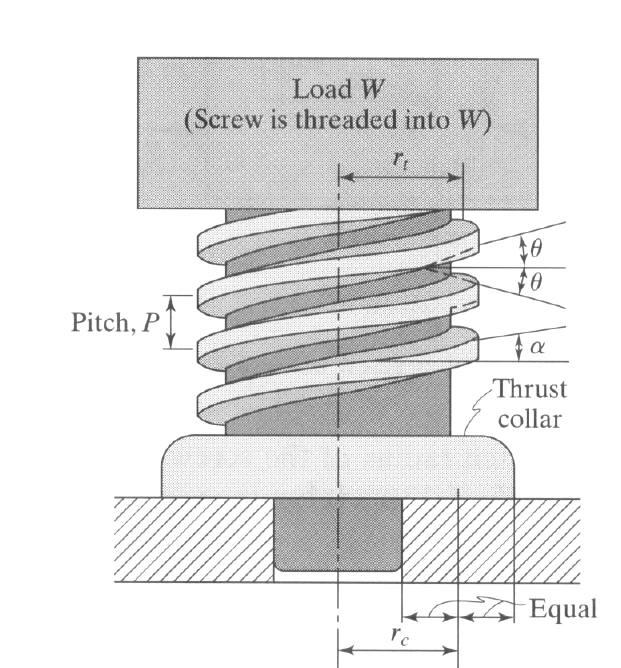
負載 \(W\) 由螺桿頂起(螺桿旋入負載),螺桿下端以軸環(thrust collar)壓在底座上。\(r_t\) 為螺紋的節圓半徑,\(r_c\) 為軸環的平均半徑,\(\theta\) 為牙側半角(Acme 螺紋 \(\theta=14\tfrac12^\circ\)),\(L\) 為導程。螺旋線展開後是一個斜面,螺旋角
$$\tan\alpha=\frac L{2\pi r_t}$$原圖對照(螺旋千斤頂)
力的分析 Force Analysis
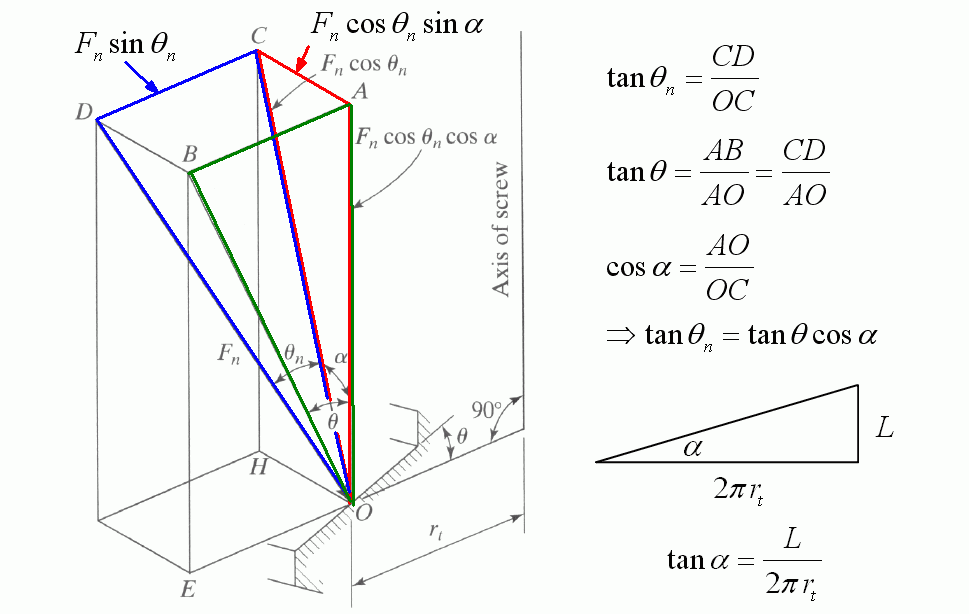
螺紋面上的法向力 \(F_n\) 與軸線的夾角 \(\theta_n\) 是在法向截面量的牙側角。由原講義的立體分解圖(OABC 等矩形):
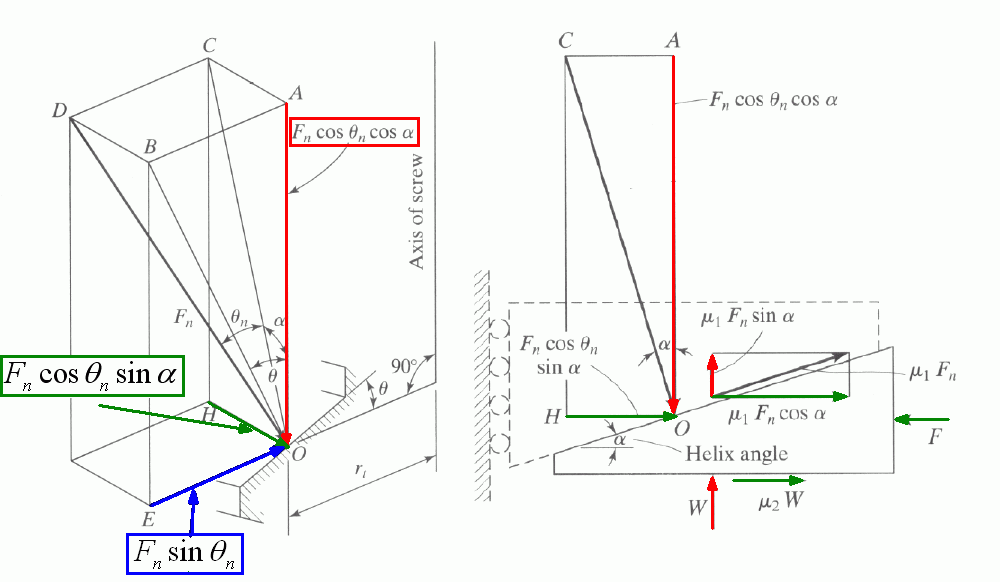
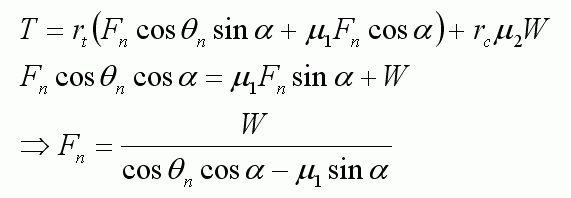
$$\tan\theta_n=\frac{CD}{OC},\qquad \tan\theta=\frac{AB}{AO}=\frac{CD}{AO},\qquad \cos\alpha=\frac{AO}{OC}\ \Longrightarrow\ \tan\theta_n=\tan\theta\cos\alpha$$\(F_n\) 分解成沿牙側的 \(F_n\sin\theta_n\)(徑向,互相抵消)與 \(F_n\cos\theta_n\)(落在斜面的法向);後者再分成軸向 \(F_n\cos\theta_n\cos\alpha\) 與切向 \(F_n\cos\theta_n\sin\alpha\)。上升時螺紋摩擦力 \(\mu_1F_n\) 沿斜面向下,軸環摩擦力為 \(\mu_2W\)。軸向力平衡與扭矩:
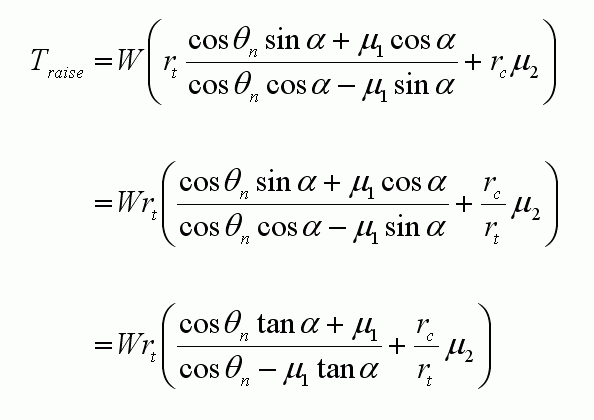
$$F_n\cos\theta_n\cos\alpha=\mu_1F_n\sin\alpha+W\ \Longrightarrow\ F_n=\frac W{\cos\theta_n\cos\alpha-\mu_1\sin\alpha}$$ $$T=r_t\left(F_n\cos\theta_n\sin\alpha+\mu_1F_n\cos\alpha\right)+r_c\mu_2W$$代入 \(F_n\),分子分母同除以 \(\cos\alpha\):
$$T_{raise}=Wr_t\left(\frac{\cos\theta_n\tan\alpha+\mu_1}{\cos\theta_n-\mu_1\tan\alpha}+\frac{r_c}{r_t}\mu_2\right)$$原圖對照(力的分析)
例題 5-3 Example 5-3
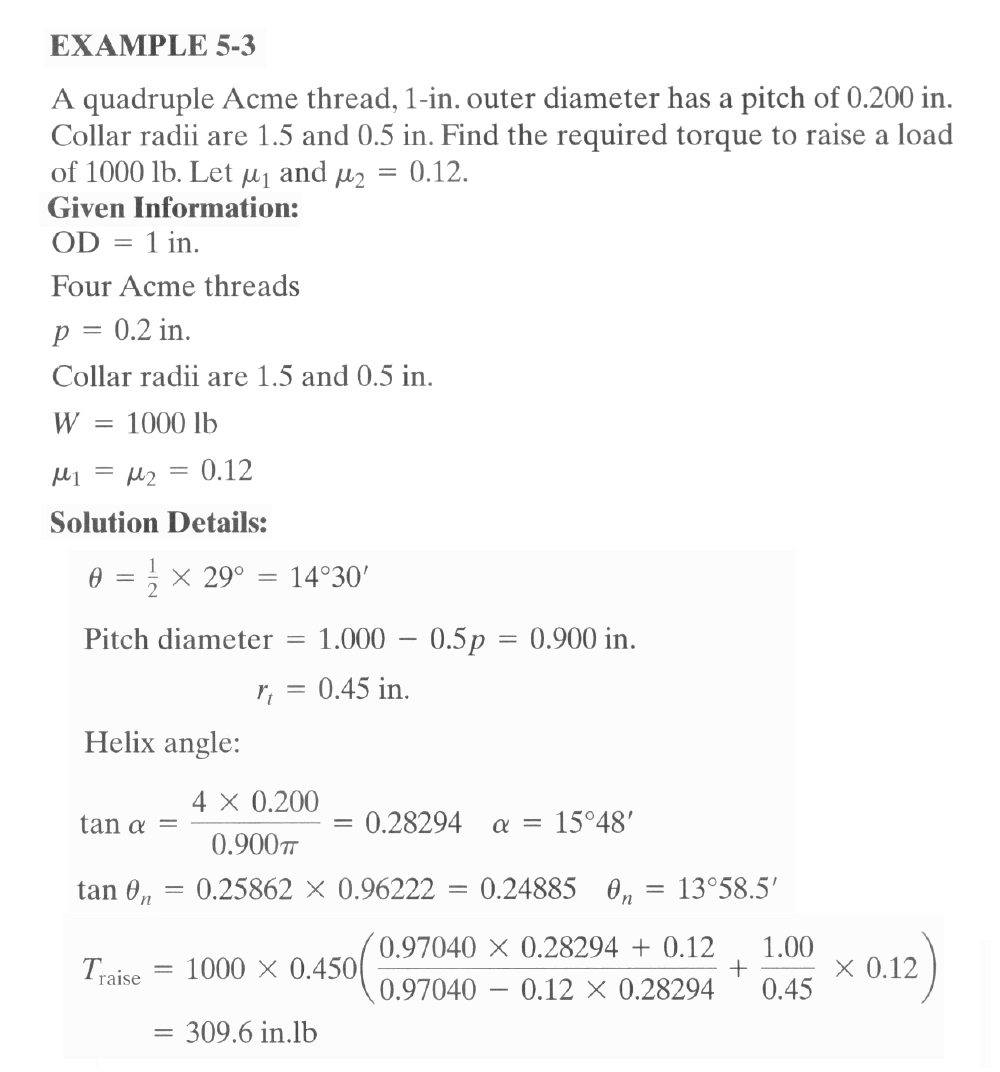
四線 Acme 螺紋,外徑 1 in、螺距 0.200 in,軸環半徑 1.5 與 0.5 in。舉升 1000 lb 需要多少扭矩?\(\mu_1=\mu_2=0.12\)。
軸環平均半徑 \(r_c=(1.5+0.5)/2=1.00\) in:
$$T_{raise}=1000\times0.450\left(\frac{0.97040\times0.28294+0.12}{0.97040-0.12\times0.28294}+\frac{1.00}{0.45}\times0.12\right)=309.6\ \text{in·lb}$$教科書附的 Excel 計算表:Module 5-1(動力螺旋的舉升與下降扭矩,可切換英制/公制)。預設值就是本例,算得 \(T_{raise}=309.6\)、\(T_{lower}=50.7\) in·lb。
原圖對照(例題 5-3)
下降與自鎖 Lowering and Self-Locking
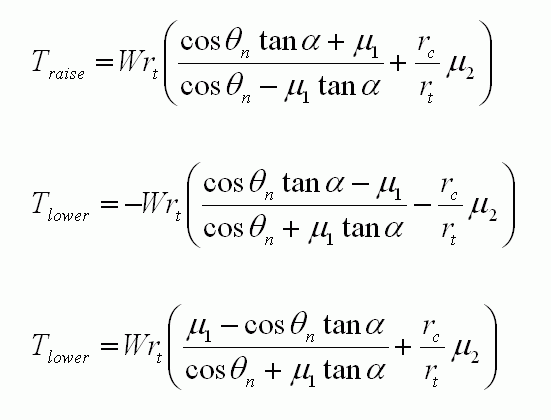
以向右的力 \(F\) 使負載下降時,\(F\) 與所有摩擦項的符號都相反:
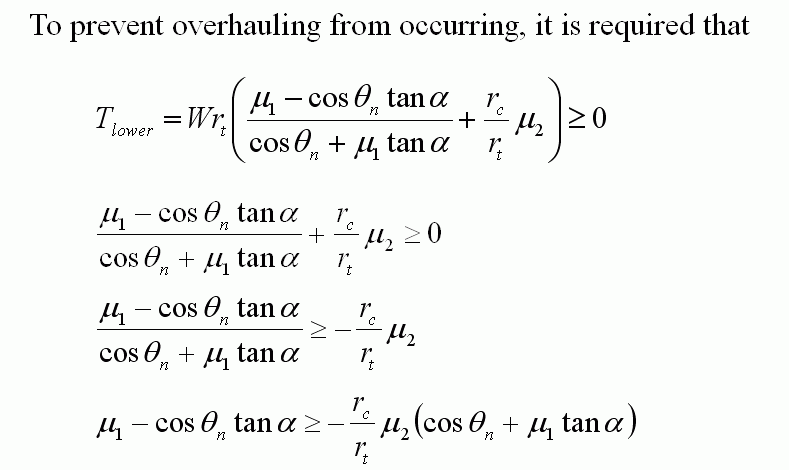
$$T_{lower}=-Wr_t\left(\frac{\cos\theta_n\tan\alpha-\mu_1}{\cos\theta_n+\mu_1\tan\alpha}-\frac{r_c}{r_t}\mu_2\right)=Wr_t\left(\frac{\mu_1-\cos\theta_n\tan\alpha}{\cos\theta_n+\mu_1\tan\alpha}+\frac{r_c}{r_t}\mu_2\right)$$若 \(T_{lower}<0\),負載會自行下降(overhauling),必須另設機構把系統鎖住。要避免自行下降,必須
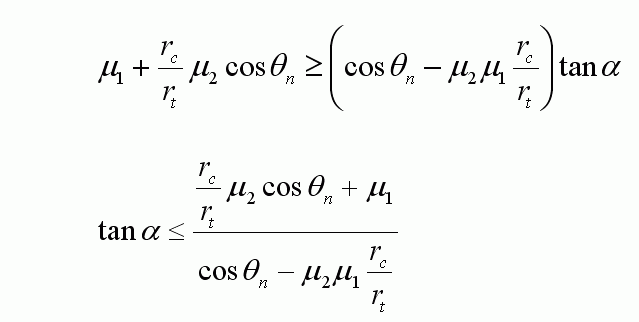
$$\frac{\mu_1-\cos\theta_n\tan\alpha}{\cos\theta_n+\mu_1\tan\alpha}+\frac{r_c}{r_t}\mu_2\ge0\ \Longrightarrow\ \mu_1-\cos\theta_n\tan\alpha\ge-\frac{r_c}{r_t}\mu_2\left(\cos\theta_n+\mu_1\tan\alpha\right)$$ $$\mu_1+\frac{r_c}{r_t}\mu_2\cos\theta_n\ge\left(\cos\theta_n-\mu_2\mu_1\frac{r_c}{r_t}\right)\tan\alpha\ \Longrightarrow\ \tan\alpha\le\frac{\dfrac{r_c}{r_t}\mu_2\cos\theta_n+\mu_1}{\cos\theta_n-\mu_2\mu_1\dfrac{r_c}{r_t}}$$若 \(\mu_2=0\)(軸環用滾動軸承),條件簡化為
$$\tan\alpha\le\frac{\mu_1}{\cos\theta_n}$$滿足這個不等式稱為自鎖:在靜態下,螺旋不會被負載倒推。但要注意,即使滿足這個不等式,振動仍可能使它自行下降。
補充:例 5-3 的螺紋本身並不自鎖:\(\mu_1=0.12\) 時自鎖要 \(\alpha\le7.06^\circ\),而四線螺紋的 \(\alpha=15.8^\circ\)。若軸環沒有摩擦,\(T_{lower}=-69.3\) in·lb,負載會自行下降;正是軸環的摩擦使 \(T_{lower}=+50.7\) in·lb。
原圖對照(下降與自鎖)


效率 Efficiency
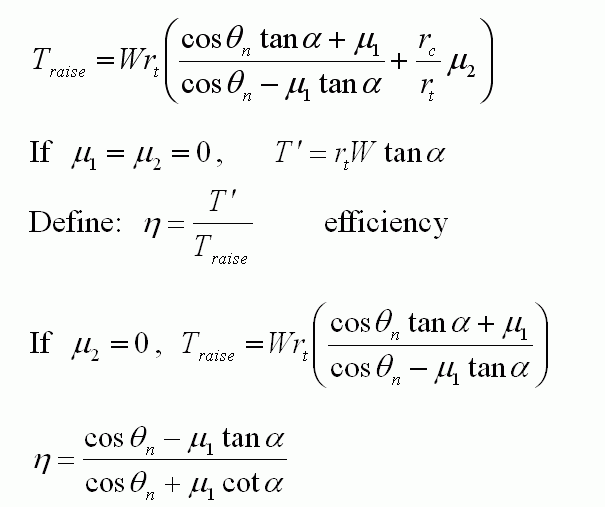
沒有摩擦時(\(\mu_1=\mu_2=0\)),舉升所需扭矩為 \(T'=r_tW\tan\alpha\)。效率定義為
$$\eta=\frac{T'}{T_{raise}}$$軸環摩擦可忽略(\(\mu_2=0\))時:
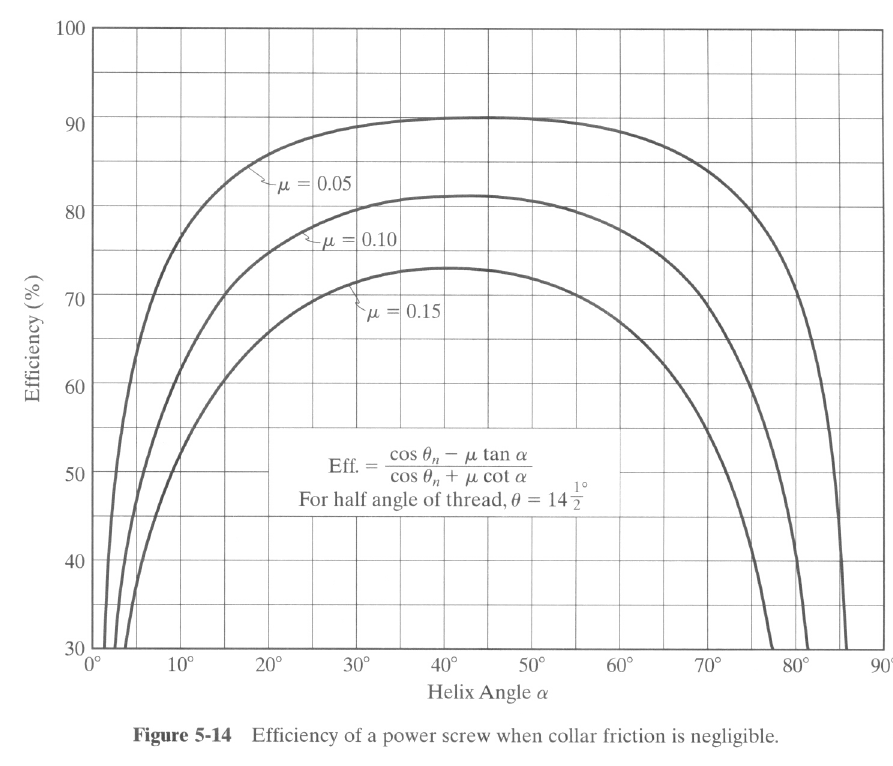
$$T_{raise}=Wr_t\frac{\cos\theta_n\tan\alpha+\mu_1}{\cos\theta_n-\mu_1\tan\alpha}\ \Longrightarrow\ \eta=\frac{\cos\theta_n-\mu_1\tan\alpha}{\cos\theta_n+\mu_1\cot\alpha}$$補充:效率在 \(\alpha\) 接近 45° 時最高,但動力螺旋的 \(\alpha\) 通常小於 10°,效率約只有 25%~65%。把自鎖條件 \(\mu_1=\cos\theta_n\tan\alpha\) 代入效率式,得 \(\eta=\tfrac12\left(1-\tan^2\alpha\right)<50\%\):自鎖的螺旋,效率必定低於 50%。例 5-3 不計軸環時 \(\eta=67\%\),計入軸環摩擦則只有 \(T'/T_{raise}=127.3/309.6=41\%\)。
原圖對照(效率與 Fig. 5-14)
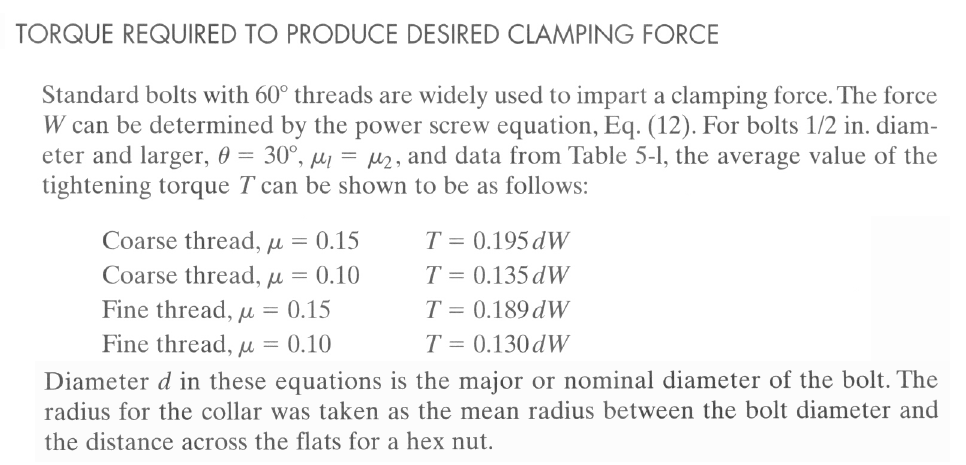
鎖緊扭矩 Torque Required to Produce Clamping Force
標準的 60° 螺紋螺栓廣泛用來產生夾緊力 \(W\),所需扭矩可用動力螺旋的公式求得。對 1/2 in 以上的螺栓,取 \(\theta=30^\circ\)、\(\mu_1=\mu_2\),並用 Table 5-1 的資料,平均的鎖緊扭矩為:
| 螺紋 | \(\mu\) | 原講義 | 本站重算(平均) |
|---|---|---|---|
| 粗牙 | 0.15 | \(T=0.195dW\) | 0.192(20 種尺寸) |
| 粗牙 | 0.10 | \(T=0.135dW\) | 0.134 |
| 細牙 | 0.15 | \(T=0.189dW\) | 0.189(10 種尺寸) |
| 細牙 | 0.10 | \(T=0.130dW\) | 0.130 |
式中 \(d\) 為螺栓的大徑(公稱直徑)。軸環半徑取螺栓直徑與螺帽對邊寬的平均半徑。
補充:本站以上述假設、對 Table 5-1 中 1/2 in 以上各尺寸逐一計算 \(T/(dW)\) 後取平均,與原講義相差 1.5% 以內。實務上常寫成 \(T=KdW\),\(K\approx0.2\),大約一半的扭矩消耗在螺帽座面的摩擦、四成在螺紋摩擦,真正用來拉長螺栓的只有一成左右;潤滑狀態對夾緊力的影響很大。
原圖對照(鎖緊扭矩)