旋轉軸的疲勞設計與傳遞功率Fatigue Design of Shafts & Power Transmitted
旋轉軸的彎曲應力會隨旋轉反覆變化,扭矩也常有波動,所以軸徑要用疲勞(二)的 Soderberg 等效應力配合破壞理論來決定。
例:旋轉軸的最小軸徑 Example: Rotating Shaft
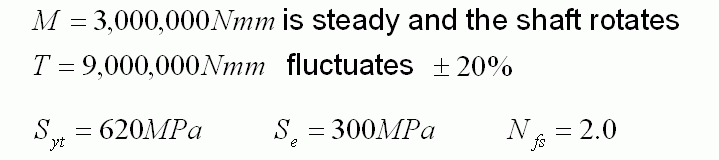
切削表面的旋轉軸承受 3 000 000 N·mm 的彎矩與 9 000 000 N·mm、變動 ±20% 的扭矩。彎曲與扭轉的應力集中因數都是 1.35。材料降伏強度 620 MPa、耐久限度 300 MPa。安全係數取 2.0,求能安全承受這些負載的最小軸徑。
A revolving shaft with machined surface carries a bending moment of 3,000,000 Nmm and a torque of 9,000,000 Nmm with ±20% fluctuation. The stress concentration factor for bending and torsion is equal to 1.35. The material has a yield strength of 620 MPa, and an endurance limit of 300 MPa. Design a shaft of minimum diameter that will safely handle these loads if the factor of safety is 2.0.
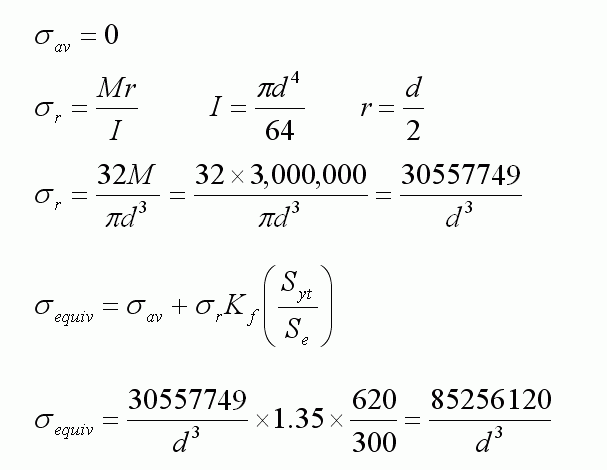
彎曲:彎矩固定但軸在轉,表面一點的應力完全反覆,平均值為 0:
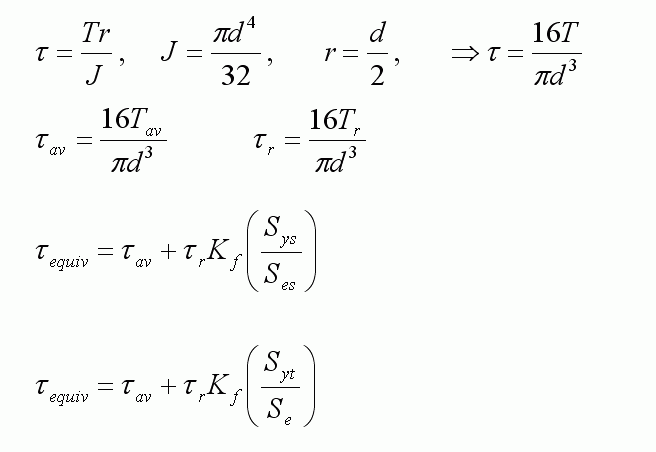
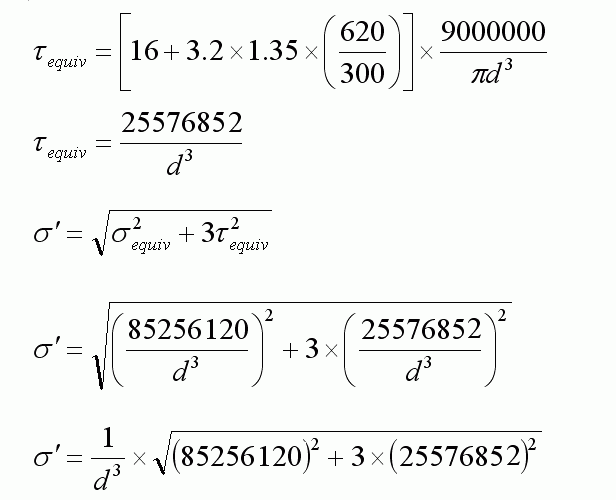
$$\sigma_{av}=0,\qquad \sigma_r=\frac{Mr}{I}=\frac{32M}{\pi d^3}=\frac{32\times3\,000\,000}{\pi d^3}=\frac{30\,557\,749}{d^3}$$ $$\sigma_{equiv}=\sigma_{av}+\sigma_rK_f\left(\frac{S_{yt}}{S_e}\right)=\frac{30\,557\,749}{d^3}\times1.35\times\frac{620}{300}=\frac{85\,256\,120}{d^3}$$扭轉:\(\tau=16T/\pi d^3\),平均扭矩 \(T_{av}=9\,000\,000\)、變動量 \(T_r=0.2\,T_{av}\);取 \(S_{ys}/S_{es}=S_{yt}/S_e\):
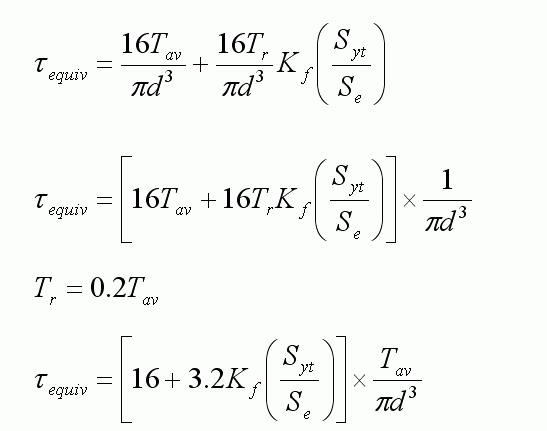
$$\tau_{equiv}=\tau_{av}+\tau_rK_f\left(\frac{S_{ys}}{S_{es}}\right)=\frac{16T_{av}}{\pi d^3}+\frac{16T_r}{\pi d^3}K_f\left(\frac{S_{yt}}{S_e}\right)=\left[16+3.2K_f\left(\frac{S_{yt}}{S_e}\right)\right]\frac{T_{av}}{\pi d^3}$$ $$\tau_{equiv}=\left[16+3.2\times1.35\times\frac{620}{300}\right]\times\frac{9\,000\,000}{\pi d^3}=\frac{(16+8.928)\times2\,864\,789}{d^3}=\frac{71\,413\,460}{d^3}$$合成(最大畸變能理論):
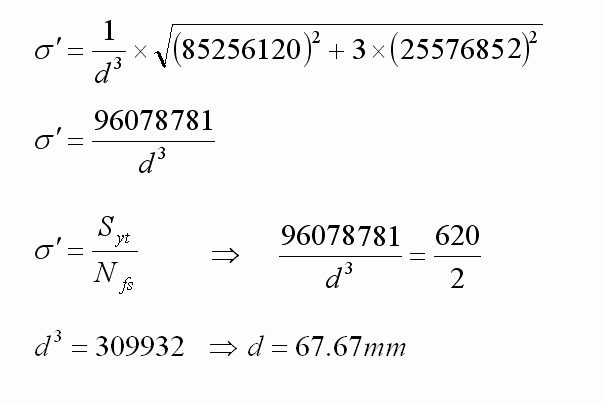
$$\sigma'=\sqrt{\sigma_{equiv}^2+3\tau_{equiv}^2}=\frac{\sqrt{85\,256\,120^2+3\times71\,413\,460^2}}{d^3}=\frac{150\,227\,000}{d^3}$$ $$\sigma'=\frac{S_{yt}}{N_{fs}}\ \Rightarrow\ \frac{150\,227\,000}{d^3}=\frac{620}{2}\ \Rightarrow\ d^3=484\,600\ \Rightarrow\ \boxed{d=78.55\ \text{mm}}$$所以應取 78.55 mm(上圖兩條曲線與 \(S_{yt}/n=310\) MPa 的交點)。
補充:若改用最大剪應力理論 \(\sqrt{(\sigma_{equiv}/2)^2+\tau_{equiv}^2}=S_{yt}/(2N_{fs})\),得 \(d=81.3\) mm,較保守。也可以看出交變彎曲(乘了 \(K_fS_{yt}/S_e=2.79\))是主要項——旋轉軸的直徑通常由彎矩決定。教科書附的 Excel 計算表:Module 3-1(傳動軸疲勞設計,含巨集)。
原圖對照(旋轉軸設計)


傳遞功率 Power Transmitted
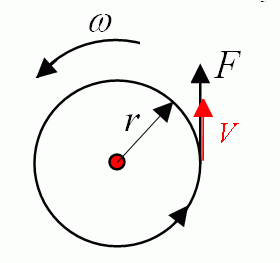
功率=力 × 速度。輪緣切線力 \(F\)、半徑 \(r\)、角速度 \(\omega\):
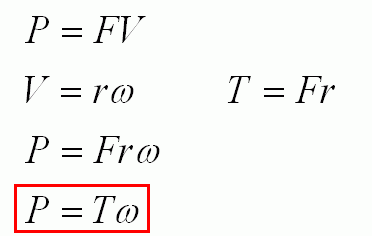
$$P=Fv,\qquad v=r\omega,\qquad T=Fr$$ $$P=Fr\omega\quad\Rightarrow\quad\boxed{P=T\omega}$$單位:
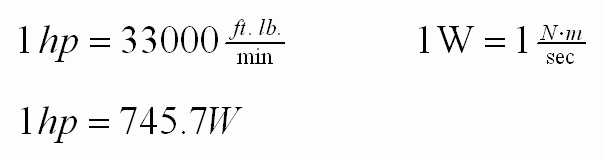
$$1\ \text{hp}=33\,000\ \frac{\text{ft·lb}}{\text{min}}=745.7\ \text{W},\qquad 1\ \text{W}=1\ \frac{\text{N·m}}{\text{s}},\qquad \omega=\frac{2\pi n}{60}\ \text{rad/s}\quad(n:\ \text{rpm})$$代入後得到常用的實用式:
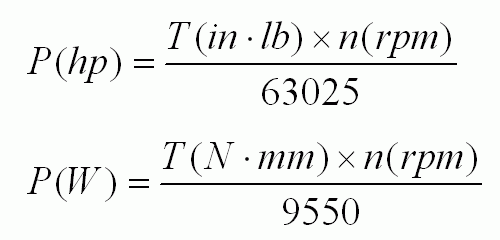
$$P(\text{hp})=\frac{T(\text{in·lb})\times n(\text{rpm})}{63\,025},\qquad P(\text{W})=\frac{T(\text{N·mm})\times n(\text{rpm})}{9550}$$補充(常數的由來):\(33\,000\times12/2\pi=63\,025\);\(60\times1000/2\pi=9549\approx9550\)。
10 hp、1750 rpm 時 \(T=63\,025\times10/1750=360\) in·lb。同樣功率下轉速越低、扭矩越大,所以減速機的低速軸比高速軸粗。
原圖對照(傳遞功率)